
NBA props are the highest volume prop market in American sports. Every night brings dozens of games, each carrying hundreds of individual player markets across points, rebounds, assists, threes and combinations of all of them. Sportsbooks cannot price that many lines with equal care, and the gaps that creates are where profit lives.
Basketball also has a quirk no other sport shares to the same degree. When one rotation player is ruled out, the minutes and shot attempts he would have taken do not vanish. They get redistributed to his teammates, often within hours of tip off, and the market does not always finish adjusting every affected line before the ball goes up. Learning to read that redistribution is the single most valuable skill in NBA prop betting.
This guide covers the markets worth your attention, what actually moves a basketball prop, and the specific traps that cost newer bettors money.
Why NBA Props Are Beatable
Three structural features work in your favor.
The first is sheer volume. A typical NBA slate carries far more individual player markets than an NFL Sunday, and oddsmaker attention is spread thin across all of them. Marquee markets get sharpened. A backup forward's rebound total does not.
The second is information speed. NBA injury news breaks constantly and often late, sometimes during warmups. Books adjust the obvious lines immediately, but the second order effects, meaning what a star's absence does to his teammates' projections, take longer to price fully across every market.
The third is measurability. Basketball is unusually well suited to projection. Minutes, usage rate and pace are stable, measurable inputs, and they translate into counting statistics far more predictably than, say, hockey goals or football touchdowns. A player's production is largely a function of how long he is on the floor and how often the offense runs through him.
The Markets That Matter
Points
The highest volume market and the most heavily bet. Efficient in marquee games, considerably less so further down the slate.
Rebounds
Driven by minutes, position and opponent pace more than by talent. Big men on fast teams facing poor rebounding opponents are the structural plays here.
Assists
Concentrated among primary ball handlers. Highly sensitive to who else is on the floor, since an assist requires a teammate to convert.
Threes Made
Higher variance than it looks. Shooters have genuine hot and cold stretches, but volume is reasonably predictable, which makes attempt based reasoning more reliable than makes based reasoning.
Points, Rebounds and Assists Combined
Usually written as PRA. Because it aggregates three categories, individual variance partially cancels out, making it one of the steadier markets on the board. A good place for newer bettors to start.
Steals and Blocks
Low volume and high variance per game. Interesting because the market gets very little attention, but the small sample within any single game makes these genuinely volatile.
Double Double and Triple Double
Popular, heavily juiced, and rarely where value sits. Fun rather than profitable.
What Actually Moves an NBA Prop
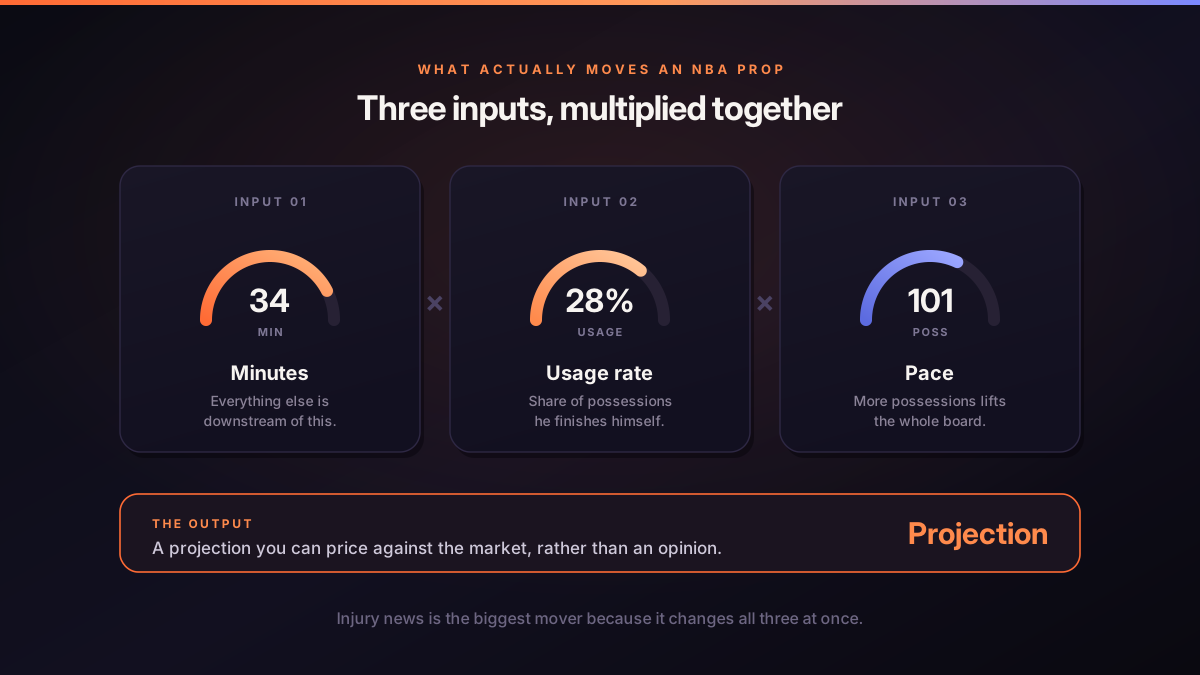
Minutes
Everything else is downstream of this. A player who logs 34 minutes has a fundamentally different projection than the same player at 24, regardless of skill. Rotation changes, foul trouble tendencies and coaching patterns all feed into expected minutes.
Usage Rate
The share of his team's offensive possessions a player finishes while on the floor. High usage players accumulate points and assists faster per minute played. When a high usage teammate sits, the remaining players' usage climbs to absorb the gap.
Pace
The number of possessions a game is expected to produce. More possessions means more of every counting statistic for everyone involved. A matchup between two fast teams lifts the entire board.
Injuries and Rest
The biggest single mover in basketball. Beyond outright injuries, teams rest healthy players on the second night of back to back games, and those decisions are frequently announced late. A confirmed absence reshapes every prop in that game, on both teams.
Matchup
Defensive quality matters, but so does defensive style. Teams that force opponents into a faster tempo lift counting stats for everyone, and specific positional matchups can suppress or inflate individual production.
The Skill That Separates Winners: Reading Usage Redistribution
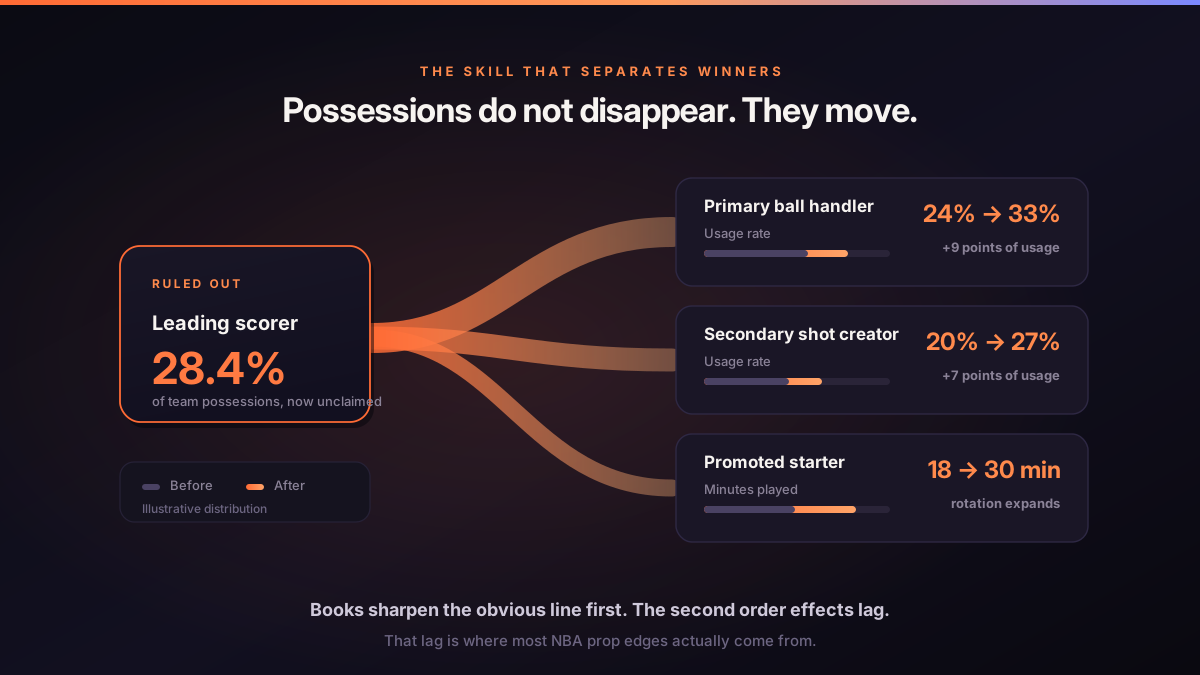
This deserves its own section because it is where most NBA prop edges actually come from.
When a team's leading scorer is ruled out, roughly a quarter of that team's offensive possessions need a new home. Those possessions do not distribute evenly. They concentrate on the remaining high usage players, particularly the primary ball handler and the next best shot creator. Minutes also expand for whoever slides into the starting lineup.
The result is that a single scratch can meaningfully lift the projection for three or four teammates at once, while books may only sharpen the most obvious one or two lines. The bettor who understands where possessions flow is working from better information than the price reflects.
The same logic runs in reverse. When a star returns from absence, teammates who have been producing at inflated rates revert, and lines sometimes lag that correction too.
This is also why timing matters so much in the NBA. Lineup news lands throughout the afternoon and evening, and the window between an announcement and a fully adjusted market can be short.
Traps That Cost Beginners Money
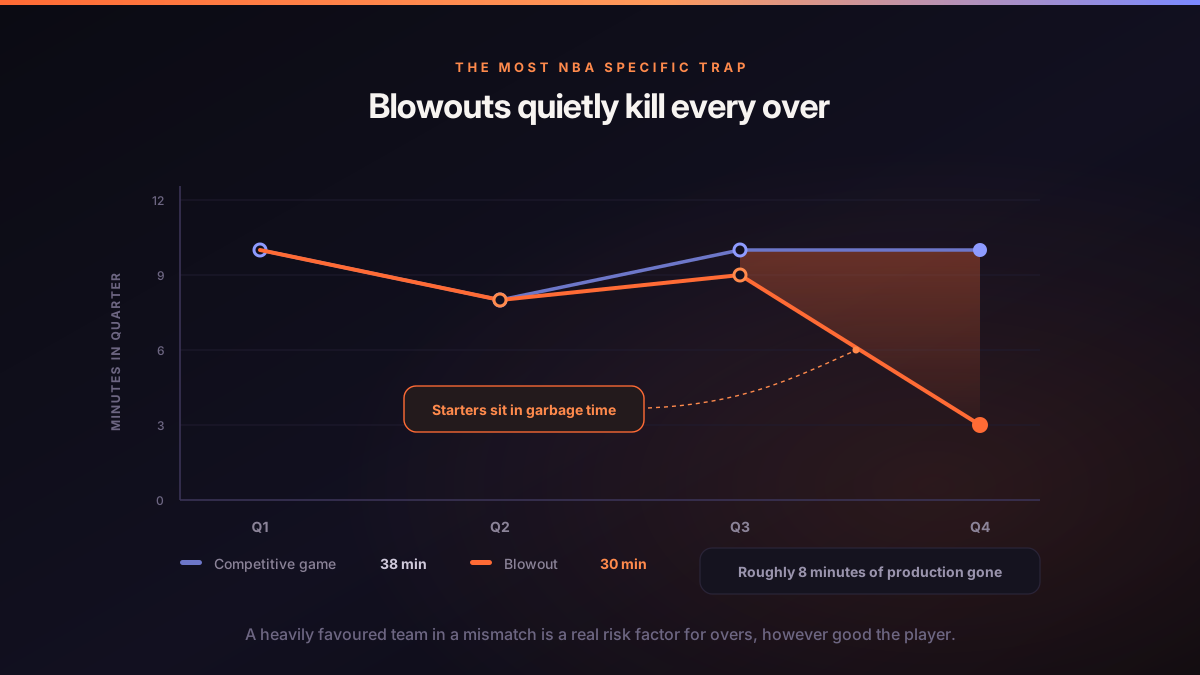
Blowout risk. This is the most distinctly NBA mistake. In a game that gets out of hand, starters sit for most of the fourth quarter, and every over on that board dies quietly. A heavily favored team in a mismatched game is a real risk factor for overs, no matter how good the player.
Betting before lineups are confirmed. NBA injury reports update late and often. Placing bets on an unconfirmed rotation means guessing at the most important input in the sport.
Chasing a big recent game. A player coming off a career night is the most publicly bet prop on the board, and the number almost always reflects that. Recency is priced in, usually generously.
Ignoring back to backs. Second nights of back to backs produce reduced minutes, rest decisions and tired legs. The schedule is one of the most reliably predictive inputs available, and it is free to check.
Stacking one game. Props from a single game move together. Several legs from the same matchup concentrate risk far more than it feels like at the time.
A Practical Workflow
Confirm the inputs first. Check the injury report and confirm the expected rotation, then look at the game total and projected pace to understand the scoring environment.
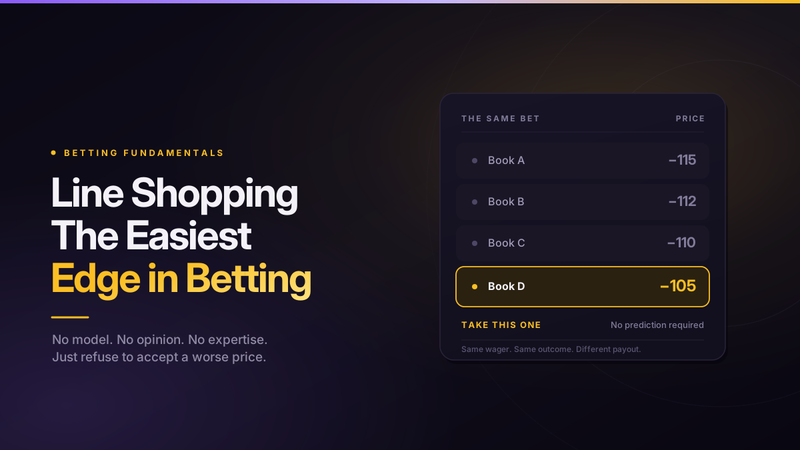
Then stop forming opinions and start comparing prices. The approach that produces consistent profit is identifying lines priced away from their true probability, which means benchmarking against the sharpest pricing in the market rather than against your own read. If that idea is new, our explainer on +EV betting covers why it is the whole game.

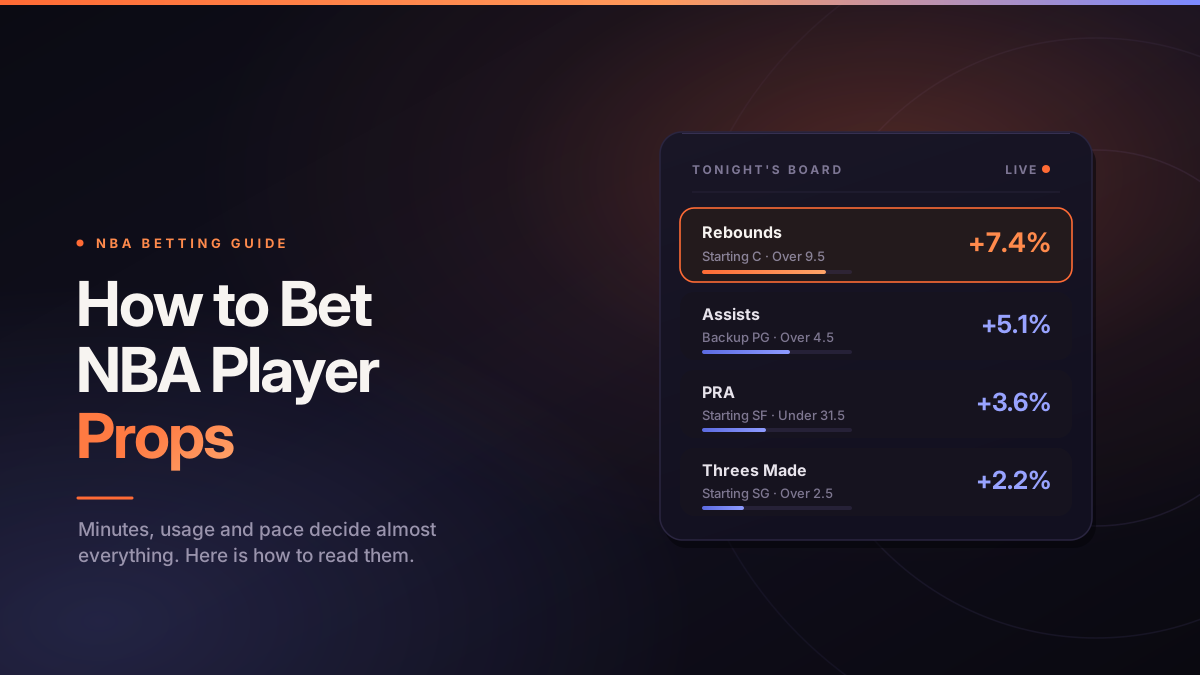
Doing that across hundreds of NBA props every night is a software problem. Our player prop optimizer scans the full board and surfaces the props carrying measurable value, and the sharp money tool shows where informed money is landing, which matters enormously on a sport where lines move fast on late news. The optimizer tutorial walks through the workflow.
Fantasy Hit Rate Tracker
Every pick our optimizer flags, graded automatically
Hit rate
58.9%
Picks graded
4,537
Days tracked
211
- WNBA 62.7%
- NBA 60.8%
- NHL 59.5%
- NFL 58.3%
- MLB 58.0%
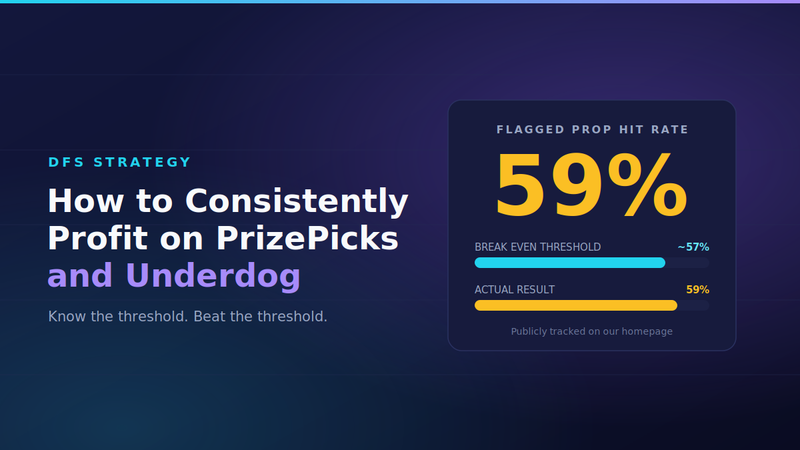
If you play pick'em apps rather than sportsbooks, the same logic applies, and our guide to profiting on PrizePicks and Underdog covers the break even threshold those formats require.
Finally, size your plays consistently. Basketball props carry real variance, and inconsistent staking amplifies it, which is why sound bankroll management belongs alongside your selections.
Setting Expectations
A long NBA season is the ideal environment for this approach, because volume is what turns a small edge into real profit. You will have nights where every over dies in a fourth quarter blowout. Across hundreds of plays, the math asserts itself.
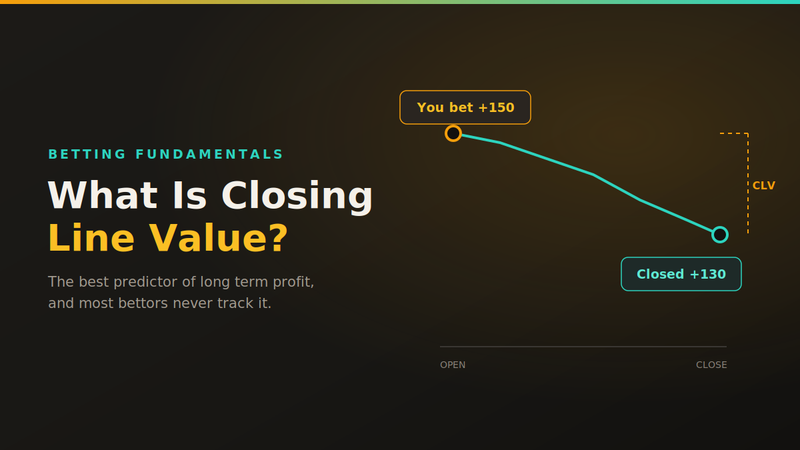
Judge your results over months rather than evenings, and track whether you are consistently getting better prices than the market closes at. That measure, covered in our guide to closing line value, will tell you whether your process is working long before your bankroll does.
The Bottom Line
NBA props reward preparation and speed. Minutes and usage drive almost everything, pace sets the ceiling, and injury news reshapes the board constantly. The bettors who profit are the ones who understand where possessions flow when a lineup changes, and who act before the market finishes adjusting.
Check the report, understand the environment, then let the numbers pick the plays. Open the player prop optimizer before tonight's slate and see which lines the books have not caught up to yet.
Please play responsibly. Sports betting carries real financial risk, and no tool or strategy guarantees a profit. If gambling is affecting your life, free and confidential support is available through the National Council on Problem Gambling. Must be of legal age in your jurisdiction.