
Most people play PrizePicks and Underdog the same way. They scroll the board, spot a few players they like, build a slip, and hope. Some weeks it works. Over a season, it almost never does. Not because those players were bad picks, but because the format itself has a break even threshold, and picking on instinct does not clear it.
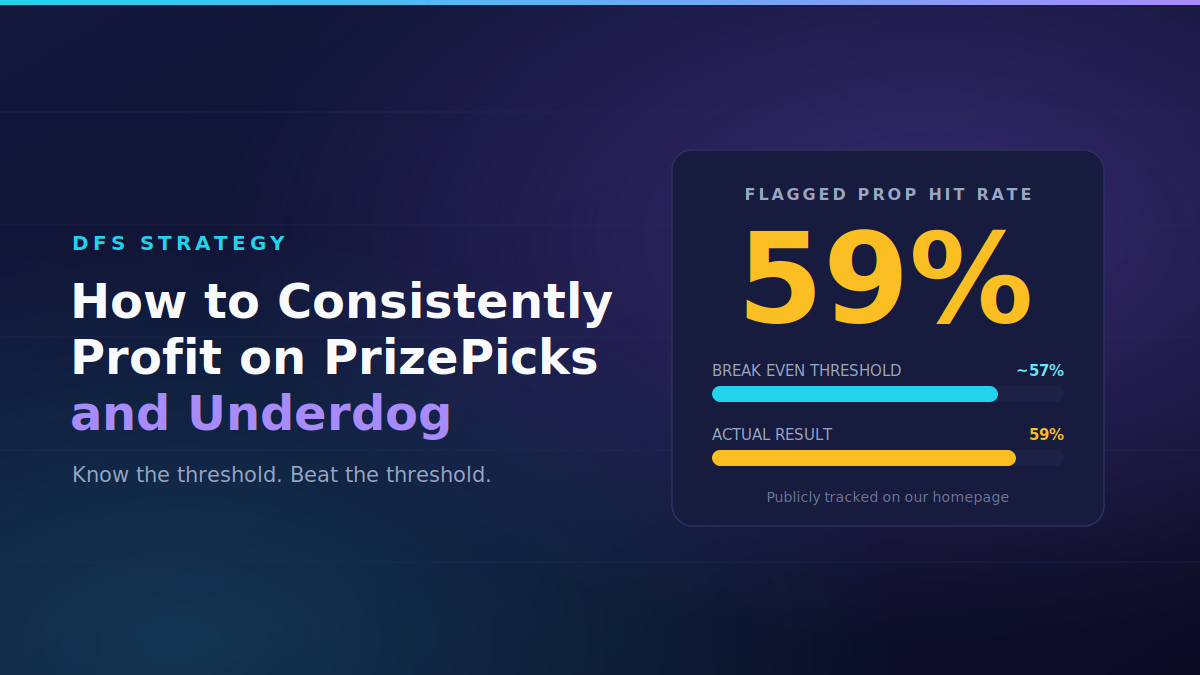
Here is the part that changes everything once you see it. That threshold is a fixed, knowable number. On typical DFS slips it sits at roughly 57 percent per pick. Not 50. Fifty seven. Once you know that number, the entire game becomes a single question: can you find picks that beat it consistently?
Our answer is documented publicly. Across the props our model flags, the realized hit rate is running at 59 percent, comfortably above that 57 percent break even bar. This guide explains where the threshold comes from, how those picks get identified, and how to build slips that actually hold the edge.
Why Most DFS Players Lose
PrizePicks and Underdog present every pick as a coin flip. Over or under, roughly even framing, pick a few and multiply your money. The interface makes it feel like a 50/50 proposition where good instincts should win.
They are not 50/50. The payout multipliers are set so that hitting half your picks loses money over time. The house edge is baked into the multiplier, not the line, which is why it feels invisible. You are not being asked to be right more often than the book. You are being asked to be right often enough to overcome the payout structure, and that bar sits meaningfully above a coin flip.
This is why so many DFS players feel like they are picking well and still bleeding money. They probably are picking well. They are just not picking well enough to clear a threshold they were never told about.
The Break Even Threshold Nobody Tells You About
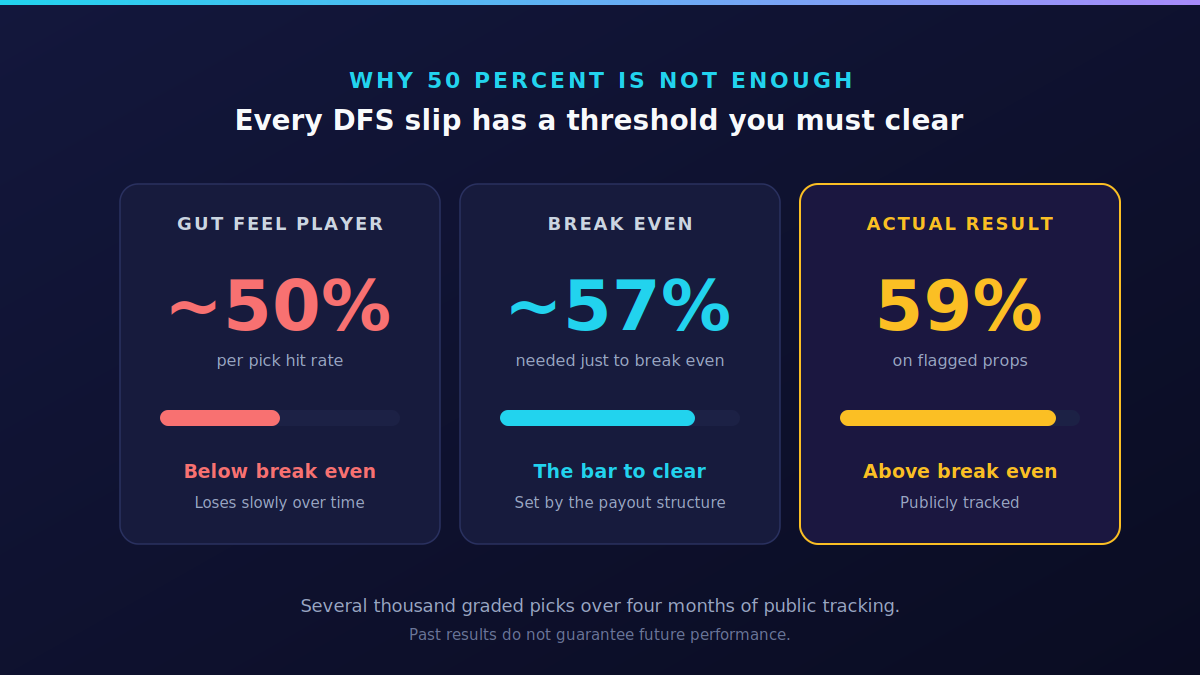
Every DFS slip has a mathematical break even point determined by the payout multiplier and the number of legs. Across typical PrizePicks and Underdog slips, that break even lands at roughly 57 percent per pick.
Sit with that number for a moment. To stop losing money, you need to be right on 57 out of every 100 picks. Not 50. The apps present each prop as a coin flip, but the payout structure quietly demands far better than a coin flip just to break even.
The exact figure shifts with your slip type. More legs generally means more variance and a higher required accuracy per leg. Flex plays lower the bar somewhat by paying on a partial hit, but they also cut the upside. What never changes is the direction. There is no configuration on either app where 50 percent per pick makes money.
That is the whole reason picking on gut feel fails. A recreational player hitting 52 or 53 percent feels like they are doing well, and by any intuitive standard they are. The math says they are still losing, just slowly enough that it takes months to notice. The only path to consistent profit is finding picks that clear 57 percent reliably, which means you need a way to know a pick's true probability before you place it.
How to Actually Find Picks Above the Threshold
Here is the method, and it is simpler than most people expect.
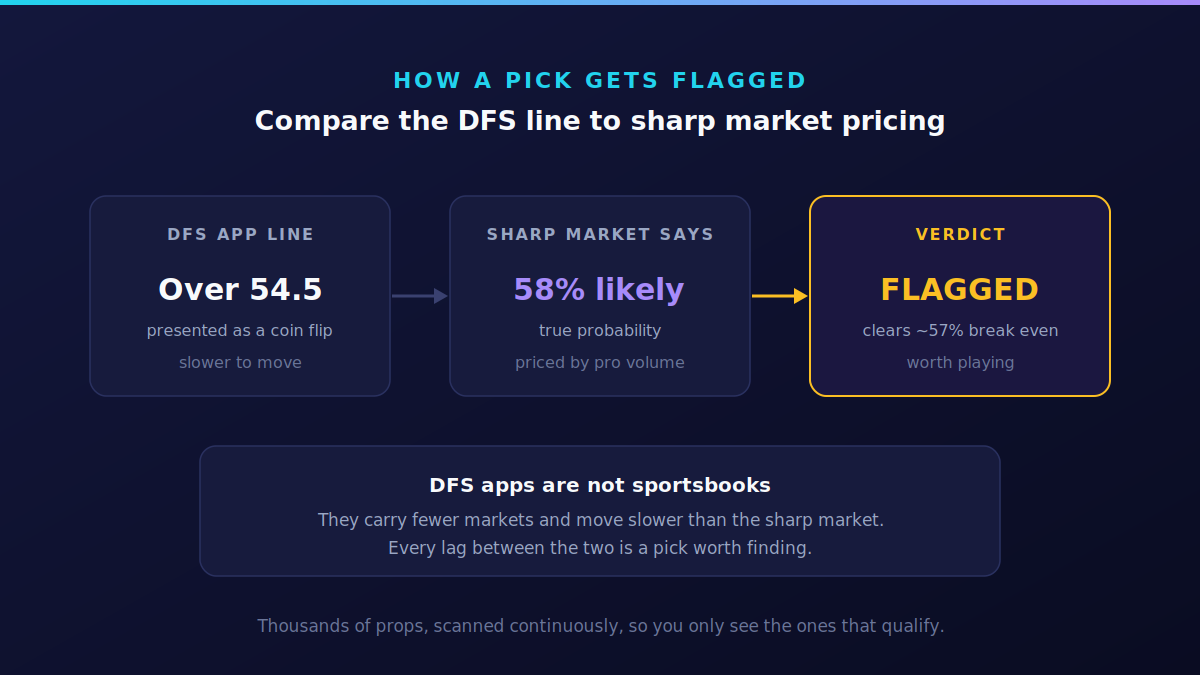
PrizePicks and Underdog are not sportsbooks. They set lines for a pick'em format, they carry a limited slice of the available props, and they do not always move as fast as the wider betting market. Traditional sportsbooks, meanwhile, take enormous volume from professional bettors, which forces their pricing toward the true probability of an outcome.
That difference is the entire opportunity. When you compare a DFS line against the sharp market's pricing for the same prop, you can calculate what the true probability actually is. Sometimes the DFS line sits right where it should. Often it does not, and when a prop's true probability is well above the break even threshold, you have found a pick worth playing.
Doing this by hand across thousands of props is not realistic. The market moves, lines shift with injury news, and the best spots disappear quickly. This is a software problem, and it is the exact problem our player prop optimizer was built to solve. It scans the full DFS board, benchmarks every prop against sharp market pricing, and surfaces the picks whose true probability is high enough to matter. Instead of browsing players and forming opinions, you open the board and see which props the numbers actually favor, ranked by edge.
Fantasy Hit Rate Tracker
Every pick our optimizer flags, graded automatically
Hit rate
58.8%
Picks graded
4,627
Days tracked
212
- WNBA 62.7%
- NBA 60.7%
- NHL 59.4%
- NFL 58.1%
- MLB 58.0%
Our Public Results: 59 Percent on Flagged Props
This is where the claim gets tested rather than asserted. We publish a live profit tracker on our homepage showing how flagged picks have actually performed.
Across the props our model flags, the realized hit rate is running at 59 percent. That figure covers several thousand graded picks over four months of public tracking, built on a model we have been refining internally for two years.
Put it next to the threshold and the significance is obvious. Break even sits around 57 percent. Flagged picks are landing at 59 percent. That two point gap does not sound dramatic, and that is exactly the point. Profitable betting is not built on blowout margins. It is built on clearing the bar by a consistent margin across a large number of picks and letting the arithmetic accumulate.
One honest note on how to use this. The model applies a screening floor of 55 percent, which sits just below break even, so the flag is a filter that narrows thousands of props down to a workable shortlist rather than a stamp guaranteeing every pick is profitable on its own. The picks carrying the largest edges are the ones doing the heavy lifting in that 59 percent average. Favor them. A prop sitting right at the screening floor is close to a coin flip against the payout structure, while one well clear of 57 percent is where the real value sits.
That distinction is the difference between playing DFS on instinct and playing it on data. One produces a slow leak you barely notice. The other produces a documented edge you can verify yourself on the tracker.
Building Slips That Profit
Finding good picks is half the job. How you assemble them decides whether that edge survives contact with variance.
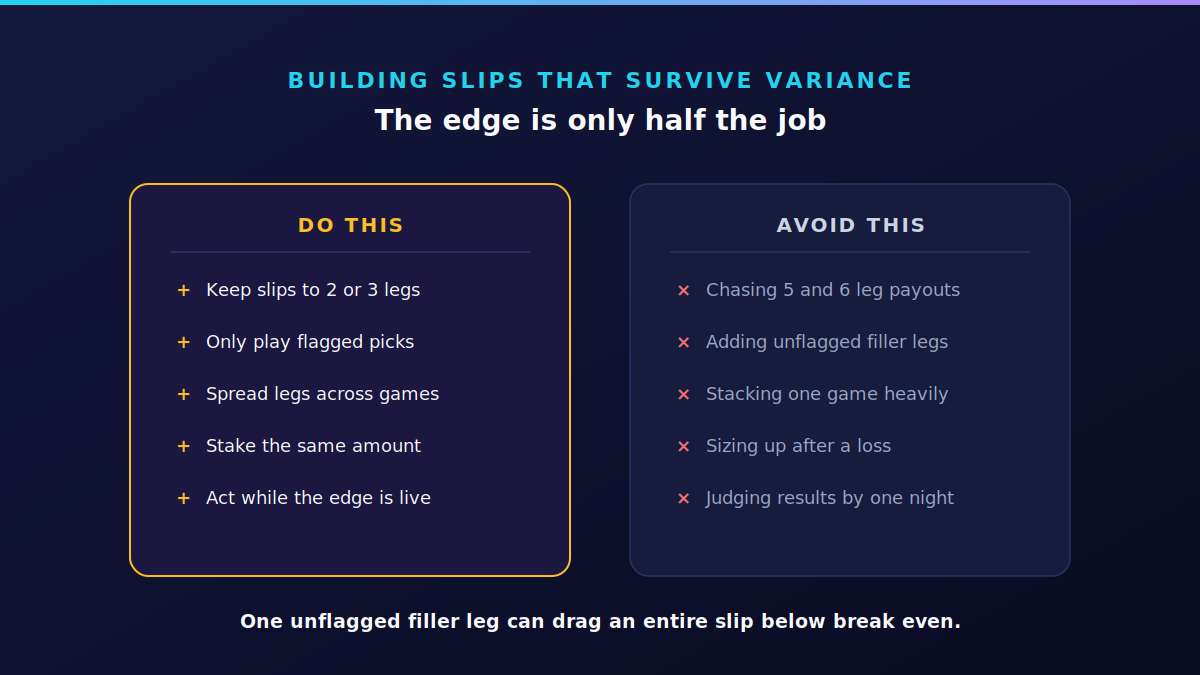
Fewer legs is almost always better. Every leg you add multiplies your risk, and the required accuracy per pick climbs with it. A two or three pick slip built entirely from flagged props will outperform a six pick swing at a huge multiplier over any meaningful sample, even though the six pick feels more exciting.
Only include picks that clear the threshold, and favor the biggest edges. The single most common mistake is finding two strong plays and then adding a third pick you like but the numbers do not support. With break even at 57 percent, one weak leg drags your entire slip underwater no matter how good the first two were. If only two props genuinely qualify, play two.
Watch correlation. Multiple props from the same game move together, which feels like an advantage and functions as concentrated risk. Spreading legs across different games keeps your outcomes independent.
Size your slips consistently. A real edge produces poor results if your staking is erratic, which is why sound bankroll management belongs alongside your pick selection.

Move quickly. DFS lines adjust as news breaks and as action comes in. A flagged prop on Thursday may not be flagged by Sunday. When the edge is live, take it.
What to Expect Realistically
A 59 percent hit rate does not mean you win 59 percent of your slips, and it certainly does not mean you win every week. You will have nights where four flagged props all miss. That is variance, and it is unavoidable in a format where individual outcomes are close to coin flips even when the odds favor you.
What a documented edge does mean is that across hundreds of picks, a two point advantage over break even compounds into real profit. This is the same principle behind all profitable betting, and our guide to +EV betting explains why the long run is the only timeframe that matters. Judge your results over a season, not a weekend.
It is also worth being clear about what the tracker is and is not. It reflects flagged picks over a specific window with a real but finite sample. Past performance does not guarantee future results, markets adapt, and no model is right forever. What it does offer is something most DFS advice does not: numbers you can look at yourself rather than promises you have to take on faith.
Beyond DFS Apps
If you also bet at traditional sportsbooks, the same logic extends across a much wider board. Our +EV plays tool covers the full sportsbook market rather than just pick'em apps, which meaningfully increases how many qualifying plays you see each week. Volume matters in this game, because profit comes from accumulating many small edges rather than landing a few big ones.
The Bottom Line
PrizePicks and Underdog are beatable, but not by picking players you believe in. They are beatable by understanding that every slip carries a break even threshold near 57 percent, and only playing picks whose true probability clears it with room to spare.
That requires knowing the true probability, which requires comparing DFS lines against sharp market pricing at a scale no person can manage manually. The tools handle that part. You handle the discipline of only playing what qualifies and sizing it sensibly.
Our flagged picks are hitting 59 percent against a break even bar near 57 percent, and you can check the tracker yourself on the homepage rather than taking our word for it. Then open the prop optimizer and see which picks clear the bar on tonight's board.
Please play responsibly. Results shown reflect a specific tracking window and are not a guarantee of future performance. Most DFS players lose money over time, and daily fantasy carries real financial risk. If gambling is affecting your life, free and confidential support is available through the National Council on Problem Gambling. Must be of legal age in your jurisdiction.