


It depends entirely on where you live. In the United States the answer is an unambiguous yes, and the rules got harsher in 2026. In the United Kingdom the answer is no, and it has been no since 2001. Several other major betting markets fall somewhere between those two poles.
A provision that took effect on January 1, 2026 caps gambling loss deductions at 90 percent. The practical result is that a bettor who breaks even for the year can still owe tax on money they never actually profited. If you bet in volume, this is the most important tax change in decades, and it deserves your attention well before filing season.
This guide covers the United States rules in detail, including the 2026 change and why high volume bettors are affected most, then compares how other major betting markets treat winnings. It is general information rather than tax advice, and anyone with meaningful betting activity should speak with a qualified tax professional in their own jurisdiction.
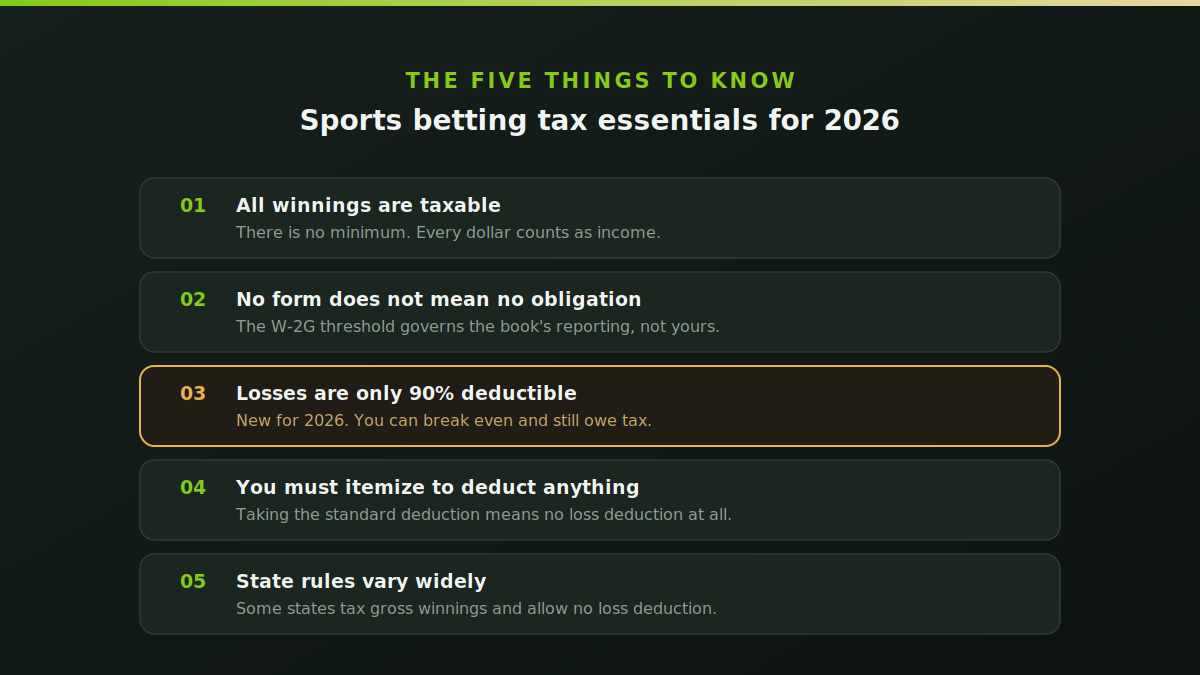
The Short Answer for US Bettors
Every dollar you win betting on sports is taxable income at the federal level. There is no minimum below which winnings become tax free. Whether you win 50 dollars on a parlay or 50,000 on a futures ticket, the IRS treats it as income you are required to report.
The amount is reported as other income on your federal return. Your losses are handled separately, and only if you itemize deductions, which is where most of the complexity lives.
You Owe Tax Even Without a Tax Form
This is the single most common misunderstanding in sports betting. Many bettors assume that if their sportsbook never sent them anything, they have nothing to report.
That is not how it works. A sportsbook issues Form W-2G only when a payout crosses specific reporting thresholds. Those thresholds determine when the book must notify the IRS, not whether your winnings are taxable. All gambling income is reportable regardless of whether any form was generated.
For 2026 the general W-2G reporting threshold rose to 2,000 dollars, replacing older thresholds that had stood since the 1970s. For sports wagering specifically, the form is generally triggered when a payout is at least 2,000 dollars and also at least 300 times the amount wagered. That combination means most ordinary sports bets never produce a W-2G, even sizable ones, while a small stake on a long shot parlay might. The threshold is also now indexed to inflation, so it will drift upward in future years.
The takeaway is simple. Receiving no paperwork is not evidence that you owe nothing.
The 2026 Change That Matters Most
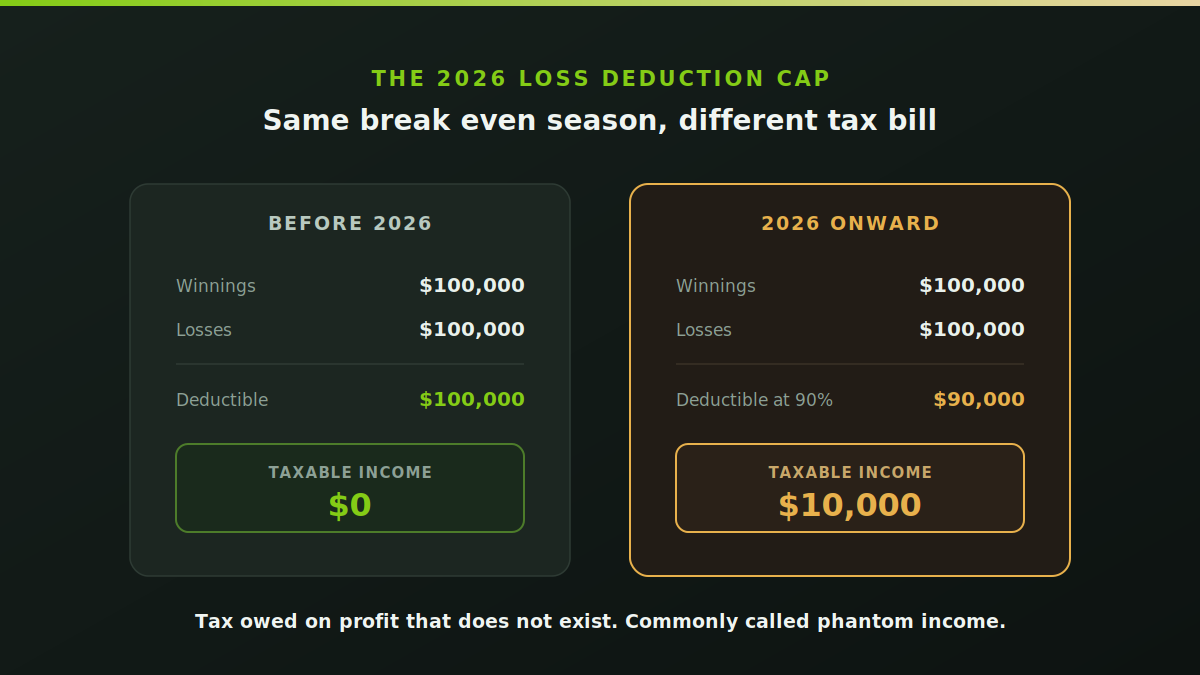
Here is the provision every serious bettor needs to understand.
Before 2026, gambling losses were deductible in full against gambling winnings, up to the amount you won. A bettor who won 100,000 dollars and lost 100,000 dollars could deduct the entire 100,000 and owe nothing, because they had no actual profit.
Starting with the 2026 tax year, that deduction is capped at 90 percent of losses. Using the same example, the bettor who won 100,000 and lost 100,000 can now deduct only 90,000, leaving 10,000 dollars of taxable income despite having made nothing at all. Commentators have labeled this phantom income, because it is tax owed on profit that does not exist.
Two further details matter. The deduction is still capped at the amount of your winnings, so losses beyond what you won remain non deductible and cannot be carried forward. And the 90 percent limit applies to professional gamblers filing on Schedule C as well, not only to recreational bettors.
Legislation has been introduced in Congress to repeal or modify the 90 percent cap, but unless and until something passes, it is the law governing the 2026 tax year.
Why High Volume Bettors Are Hit Hardest
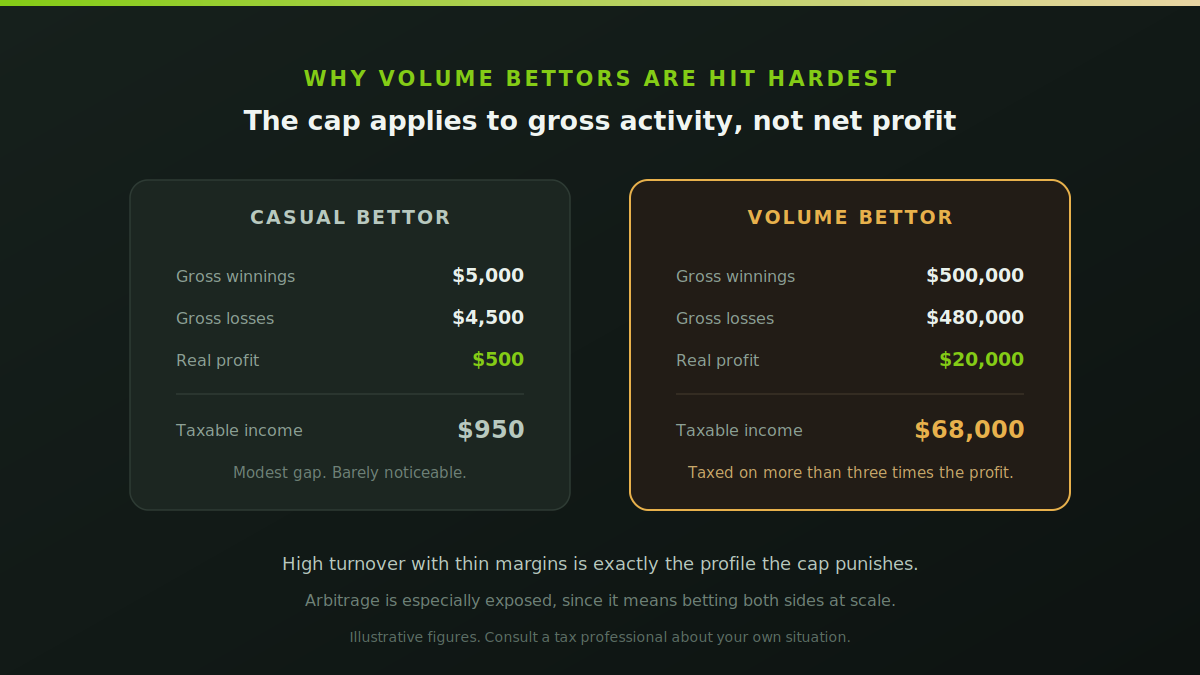
This is the part most general tax articles miss, and it matters enormously if you bet the way this site encourages.
The 90 percent cap applies to your gross losses, not your net result. A bettor who places a handful of wagers a year has small gross numbers and feels almost nothing. A bettor placing thousands of positive expected value bets accumulates enormous gross winnings and enormous gross losses, even while netting a modest profit.
Consider a bettor who wagers heavily across a season, winning 500,000 dollars in gross payouts and losing 480,000, for a genuine profit of 20,000. Under the old rules they would owe tax on that 20,000. Under the 90 percent cap, their deductible losses fall to 432,000, leaving 68,000 dollars of taxable gambling income on a 20,000 dollar profit.
That is the structural problem. The approaches that produce real edges, whether that is +EV betting at volume or arbitrage betting where you deliberately place offsetting wagers, generate exactly the high gross, low margin profile the cap punishes most. Arbitrage is particularly exposed, since the strategy involves betting both sides and collecting a small guaranteed return on enormous turnover.
None of this makes those strategies unprofitable. It does mean the tax consequences deserve real planning rather than an afterthought in April, and it is a strong argument for talking to a tax professional who understands gambling specifically.
The Itemizing Problem
There is a further catch that catches many bettors by surprise. Gambling losses are an itemized deduction, which means you can only claim them if you itemize rather than taking the standard deduction.
Because the standard deduction is substantial, many people find that itemizing does not make sense for their overall situation. Those bettors end up reporting their full gambling winnings as income while deducting none of their losses, which can produce a tax bill dramatically larger than their actual profit.
If you bet with any regularity, whether itemizing makes sense is a calculation worth running deliberately rather than defaulting to the standard deduction.
State Taxes Vary Widely
Federal rules are only half the picture. States treat gambling income very differently.
Some states have no income tax at all, so gambling winnings face no state level liability. Others tax winnings as ordinary income and permit loss deductions that mirror the federal treatment. A number of states tax gross gambling winnings while allowing no deduction for losses whatsoever, which is the harshest combination and can create a state tax bill that exceeds your actual profit entirely.
You may also owe tax in a state where you placed bets even if you do not live there, depending on that state's rules and any reciprocity agreements. Because the variation is so wide, state treatment is worth confirming for your specific situation rather than assuming it follows the federal approach.
How Other Countries Treat Betting Winnings
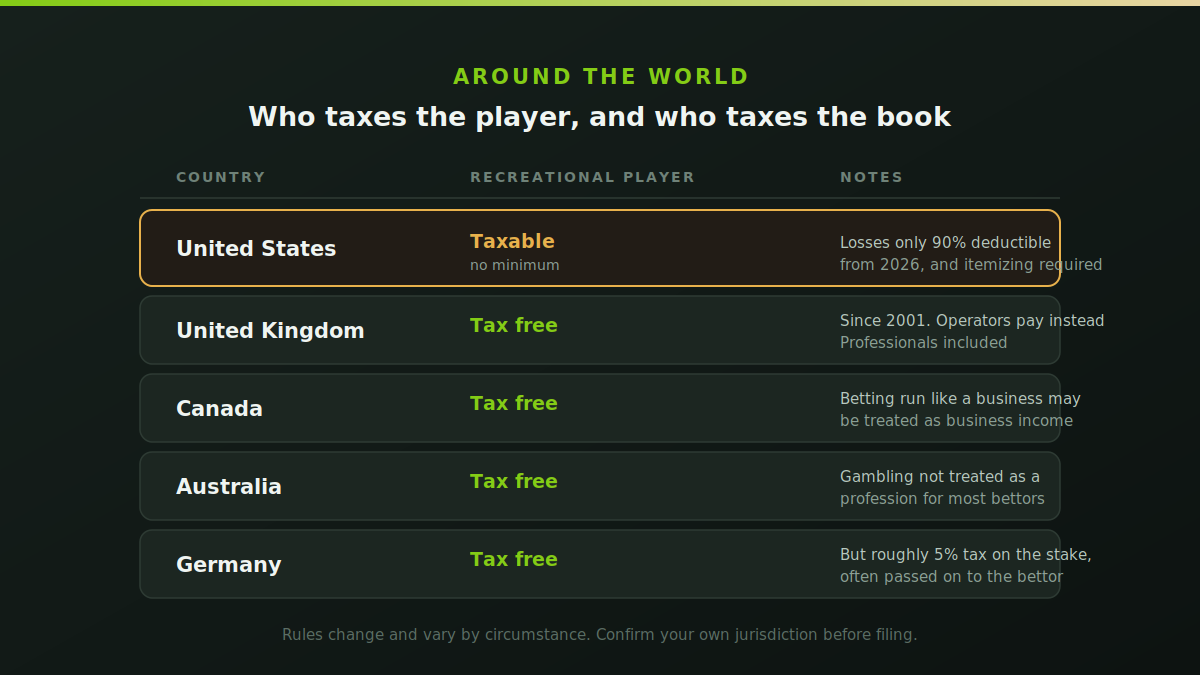
The United States is unusually aggressive here. Many major betting markets tax the operator instead of the player, which produces a very different experience for bettors.
United Kingdom
Betting winnings are tax free for individuals, and have been since 2001, when the tax burden shifted from players to operators. This holds regardless of how much you win or how often you bet. HMRC does not treat gambling as a trade, so even people who bet professionally generally pay no tax on their winnings. The treatment also applies regardless of where the bookmaker is licensed. The one caveat worth knowing is that interest or investment returns earned on your winnings afterwards are taxable in the normal way, since that income is no longer gambling income.
Canada
Gambling winnings are generally not taxable for recreational players. The important nuance is that someone whose betting resembles a business, in its scale, organisation and reliance on skill, may have that activity treated as business income instead. Where exactly that line sits is fact specific, which makes professional advice genuinely worthwhile for anyone betting seriously.
Australia
Recreational gambling winnings are not taxed, on the reasoning that gambling is not a profession and winnings are not earned income. As in Canada, someone operating at a scale that looks like a business may face a different assessment.
Germany
Winnings are generally tax free for recreational players, but Germany taxes the stake rather than the result. Sports bets placed by German residents carry a tax of roughly 5 percent of the amount staked, which operators must pay and frequently pass on to customers. Some bookmakers absorb it to stay competitive. Commercial or professional gambling can be taxable.
Elsewhere in Europe
Treatment varies considerably. Some countries follow the UK model and leave players untaxed while taxing operators, Denmark being one example. Others, such as Spain, treat winnings as taxable income for the player. There is no single European approach, so the only reliable answer is your own country's rules.
A note for everyone outside the US
Where winnings are untaxed, losses are correspondingly not deductible. That symmetry matters less than it sounds, because a bettor who keeps every dollar of profit is in a far better position than one who deducts losses but pays tax on net winnings. It does mean the 90 percent cap that dominates US planning simply has no equivalent in most of these markets.
Rules change, and this comparison is a starting point rather than a substitute for checking your own jurisdiction. If you bet while travelling, or use a book licensed in another country, the picture can get more complicated still.
Keep Records All Year
Whatever your situation, documentation protects you. The practical habit is to maintain a running log of your betting activity rather than reconstructing it in April from memory and scattered app screenshots.
A useful record includes the date, the sportsbook or platform, the type of wager, the amount staked, and the result. Most sportsbooks and DFS apps provide downloadable transaction histories, and pulling those periodically is far easier than retrieving a full year at once. If you bet across multiple books, which most value bettors do, consolidating everything into a single spreadsheet makes the eventual filing far simpler.
Good records serve a second purpose beyond taxes. Tracking your results honestly is also how you learn whether your process is actually working, which is the same discipline behind measuring closing line value and judging results across a full season.


Common Mistakes
Assuming no form means no obligation. The W-2G threshold governs reporting by the sportsbook, not your own responsibility.
Reporting only net profit. Winnings and losses are handled separately. Netting them in your head and reporting the difference is not how the forms work.
Forgetting about state taxes. The federal calculation is only part of what you may owe.
Ignoring the 90 percent cap until filing season. For high volume bettors this can be a large and entirely unwelcome surprise. Knowing the number in advance lets you set money aside.
Keeping no records. Without documentation, substantiating losses becomes very difficult if your return is ever questioned.
The Bottom Line
In the United States, sports betting winnings are taxable with no minimum exemption, and the obligation exists whether or not a form arrives. The 2026 change to the loss deduction makes the arithmetic meaningfully worse, particularly for anyone betting in volume, because the 90 percent cap taxes gross activity rather than real profit. Bettors in the UK, Canada and Australia face a far simpler picture, with recreational winnings generally untaxed.
The practical response is unglamorous but effective. Keep thorough records throughout the year, understand that itemizing is what unlocks any loss deduction at all, check how your state or country treats gambling income, and set money aside rather than being surprised. If your betting is substantial, the cost of an hour with a tax professional who understands gambling is trivial against what the 90 percent cap can produce.
This article is general information, not tax or legal advice. Tax rules change frequently, legislation affecting the 90 percent cap has been introduced in Congress, and treatment varies by country, state and individual circumstances. Consult a qualified tax professional in your own jurisdiction, and verify current rules with the relevant tax authority before filing.
Please play responsibly. Sports betting carries real financial risk. If gambling is affecting your life, free and confidential support is available through the National Council on Problem Gambling. Must be of legal age in your jurisdiction.