


On this page
- What Is a Unit in Sports Betting?
- Why Bettors Measure in Units, Not Dollars
- The Honest Answer: What Is Realistic
- The Math: How Units Actually Add Up
- What Separates 150 Units From 400 Units
- Set Realistic Expectations Along the Way
- How to Actually Reach These Numbers
- Common Mistakes That Cap Your Units
- The Bottom Line
If you have ever searched how many units you can realistically make betting on sports, you have probably found a mess of vague answers and wild promises. Some sites dangle fantasies of quitting your job. Others shrug and say it depends. Neither helps you set a real expectation. So here is a straight, honest answer built on actual results rather than hype.
Across our disciplined members, a realistic range is roughly 150 to 400 units over a full season. That is not a marketing number pulled from thin air. It is the span we genuinely see among bettors who follow a proven process, stay consistent, and put in real volume. Below we break down what that means, the simple math that produces it, and exactly what separates the bettor who makes 150 units from the one who makes 400.
What Is a Unit in Sports Betting?
A unit is a standardized bet size, a way to measure your wagers and your results independent of how much money you actually have. Most bettors set one unit equal to 1 percent of their bankroll. If your bankroll is 5,000 dollars, one unit is 50 dollars. If it is 20,000 dollars, one unit is 200 dollars.
Betting in units keeps your staking consistent and, just as importantly, lets you measure performance in a way that means something. When someone says they made 250 units last season, you understand their result no matter what their bankroll was.
Why Bettors Measure in Units, Not Dollars
Dollars are personal. Units are universal. A bettor working with a 1,000 dollar bankroll and another working with a 100,000 dollar bankroll can both report 250 units, and it tells you the same thing about the quality of their betting even though the dollar figures are worlds apart.
This is why every serious handicapper, tipster, and betting service reports results in units. It strips out bankroll size and isolates what actually matters, which is the skill and consistency of the betting itself. It is the honest way to talk about performance.
The Honest Answer: What Is Realistic

Here is the number you came for. For a disciplined bettor who sticks with a solid process across a full season, roughly 150 to 400 units is a realistic outcome. That is the real span we observe across our winning members.
Now the honesty that most sites skip. This range describes members who stay disciplined, follow the process, and place real volume, not the average casual bettor. Most casual bettors lose money over time, full stop. Sports betting is genuinely difficult, variance is unavoidable, and no result is ever guaranteed. The 150 to 400 range reflects what is achievable with the right tools, real discipline, and a large sample of smart bets placed consistently across the season. It is not what happens automatically, and anyone who tells you otherwise is selling a fantasy.
With that framing in place, the encouraging part is that this range is not luck. It is the predictable output of a simple formula.
The Math: How Units Actually Add Up
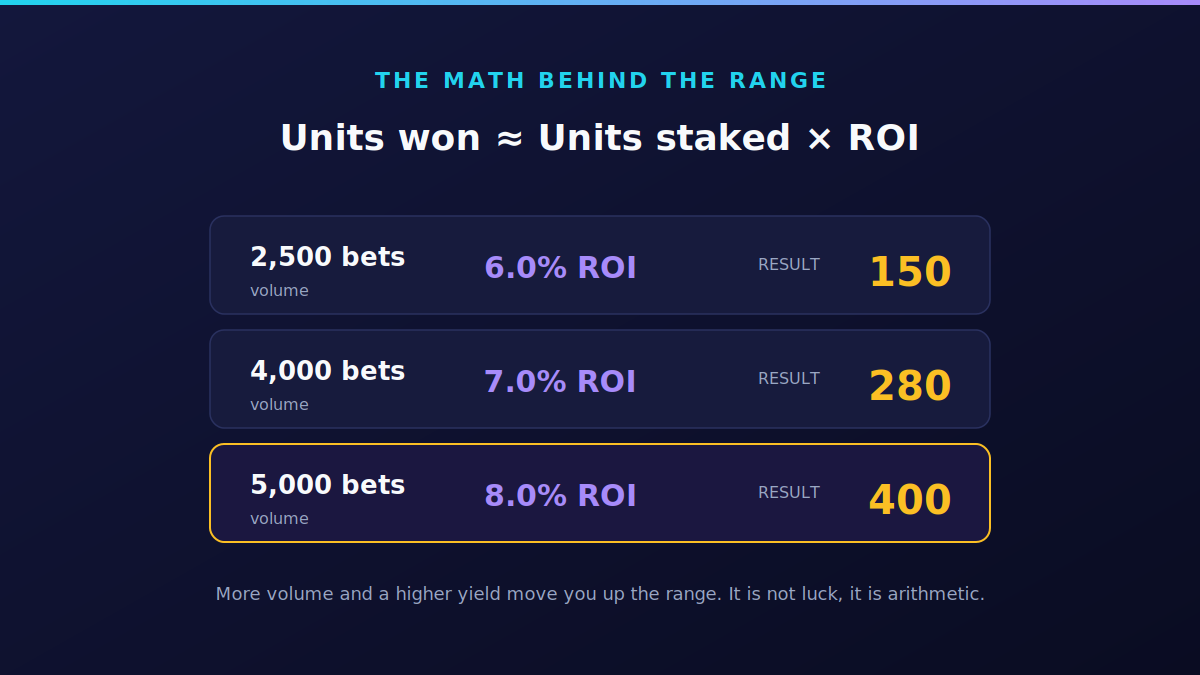
Two things drive your unit total: how many bets you place and your return on investment, often called yield. The relationship is refreshingly simple.
Units won ≈ Total units staked × ROI
Say you place 2,500 bets of one unit each over a season. You have staked 2,500 units. At a 6 percent ROI, that produces 150 units of profit. Push your volume to 5,000 bets and lift your ROI to 8 percent, and you arrive at 400 units. Something in between, such as 4,000 bets at a 7 percent ROI, lands you around 280 units.
That is the entire secret behind the range. The bettors at the top are not blessed by fortune. They simply place far more quality bets and earn a slightly higher return on each one. A long term ROI in the 5 to 8 percent range is strong and realistic for a sharp bettor, and reaching the upper end of the unit range is mostly a matter of stacking that yield across serious volume, often many bets every single day across multiple sports and markets.
What Separates 150 Units From 400 Units
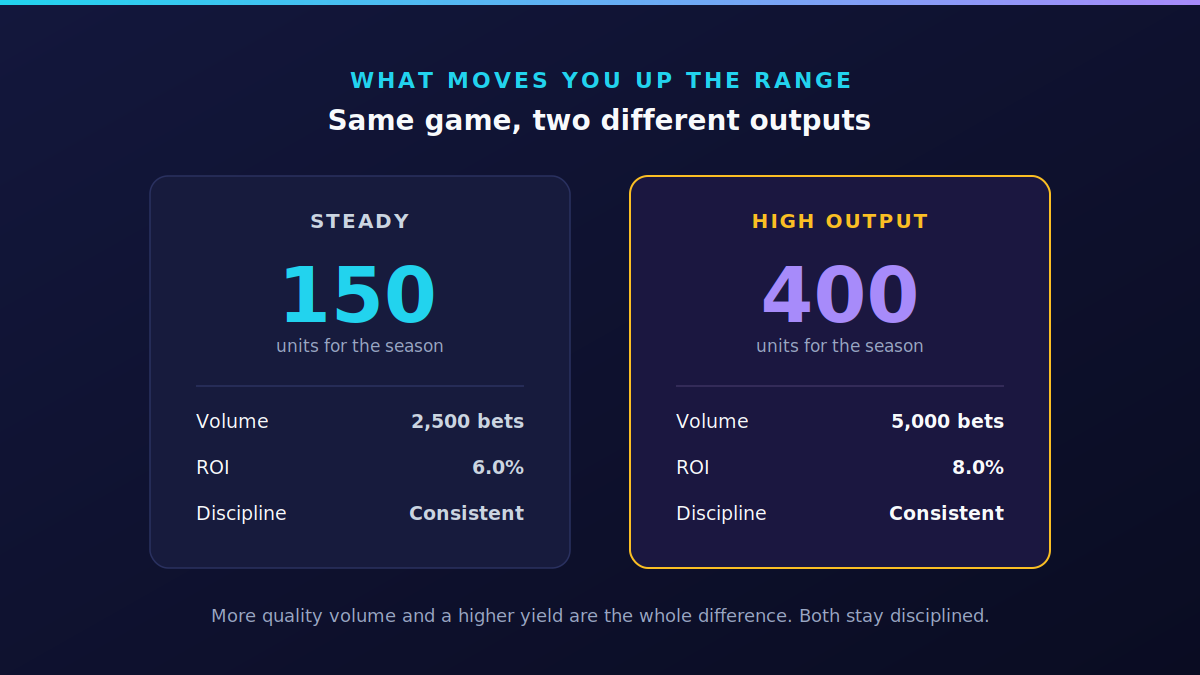
Three levers move you up the range, and all three are within your control.
The first is volume. More quality opportunities mean more chances to compound your edge across the season. Reaching the top of the range genuinely requires high output, often thousands of bets across a year. The catch is that volume only helps when every bet carries positive expected value. Piling on bad bets does the opposite.
The second is ROI. A higher yield per bet scales your entire total. This is where finding bigger, cleaner edges truly pays off, and where good tools separate winners from the pack. Our guide to +EV betting explains the principle that drives yield in the first place.
The third is discipline. Skipping the bets that do not meet your criteria, sizing every wager consistently, and refusing to chase losses is what keeps your ROI intact over thousands of bets. Discipline is boring, and it is also the single biggest reason some members reach 400 units while others stall at 150.
Set Realistic Expectations Along the Way
A season of betting is a marathon, not a sprint. Even the members who finish near 400 units endure losing weeks and cold months on the way there. Downswings are not a sign that something is broken. They are simply variance doing its thing while your edge grinds forward underneath.
The mistake is judging your results over a weekend or a single bad run. Units accumulate across a large sample, so the only fair way to measure yourself is over hundreds or thousands of bets. Zoom out, trust the process, and let the math play out.
How to Actually Reach These Numbers
Hitting the upper end of the range comes down to feeding all three levers at once. Here is where the tools do the heavy lifting.
Consistently finding positive expected value bets is what builds your ROI, and our +EV plays tool is designed to surface those edges in real time so you can place serious volume without sacrificing quality. For a lower variance stream of units, arbitrage betting locks in guaranteed profit regardless of outcome, which smooths out the swings across a season and adds volume you can trust. If player props are your market, the same edge finding logic applies through our player prop optimizer tutorial.
None of it works without correct staking, so pair your bet selection with sound bankroll management and the Kelly criterion to size each unit the right way. Together, these turn the abstract 150 to 400 range into a concrete, repeatable process.

Common Mistakes That Cap Your Units
A few habits quietly keep bettors stuck at the bottom of the range or worse. Placing too few genuine +EV bets starves your volume. Chasing losses with oversized wagers wrecks your ROI in a single bad night. Sizing your units inconsistently makes your results impossible to trust or measure. And the most common of all, overestimating your own edge and betting negative expected value spots, guarantees you leak units no matter how many bets you place.
Avoid those four, and you are already ahead of the vast majority of bettors.
The Bottom Line
A realistic season for a disciplined, high volume bettor lands somewhere between 150 and 400 units, and that outcome is not luck. It is volume multiplied by edge, protected by discipline. Find enough positive expected value bets, earn a solid yield on each one, size your stakes correctly, and give the season enough time to let variance settle.
Do that consistently, and the range stops being a question you Google and becomes a number you produce. Start building your edge with the Parlayers +EV plays tool and put the math to work across your next season.
Please play responsibly. The results described here reflect disciplined members and are not a guarantee of future performance. Most bettors lose money over time, and sports betting carries real financial risk. If gambling is affecting your life, free and confidential support is available through the National Council on Problem Gambling. Must be of legal age in your jurisdiction.