
Arbitrage locks in a small profit no matter what happens. Middling does something stranger and, when it works, considerably better. You take both sides of the same game at two different numbers, and if the final score lands in the gap between them, both bets win.
Most of the time it costs you a few dollars. Occasionally it pays twenty times that. The whole technique comes down to whether the gap you create is wide enough, and whether it sits on the right numbers.
Here is how it works, with the arithmetic laid out.
What a Middle Actually Is
A middle exists when you hold two bets on opposite sides of the same game, taken at different lines, with a range of results where both of them cash.
The classic version comes from line movement. You bet one side early. The number moves. You bet the other side at the new number. Now you are holding both teams at prices that no longer overlap cleanly, and the space between them is yours.
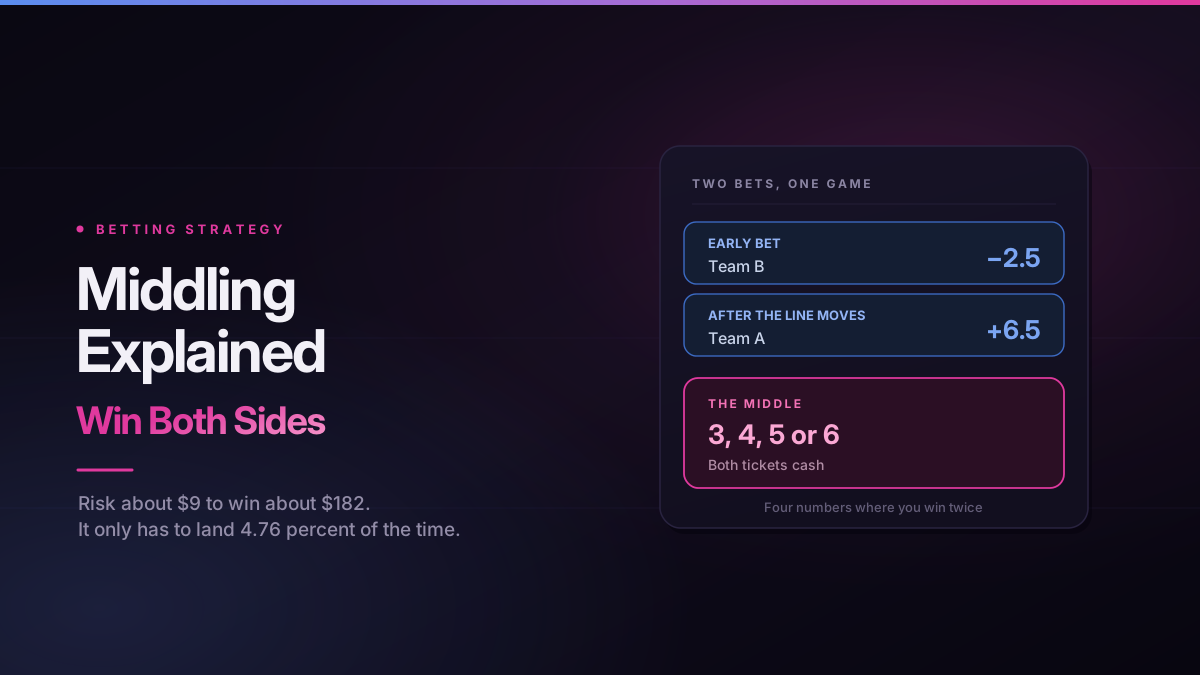
Say a spread opens with Team B favoured by 2.5 points and you back them at minus 2.5. Later in the week their opponent's starting quarterback is ruled out and the line jumps to Team B minus 6.5. You now take the other side at plus 6.5.
Look at what you are holding:
| Result | Minus 2.5 bet | Plus 6.5 bet | Outcome |
|---|---|---|---|
| Team B wins by 7 or more | Wins | Loses | One of two |
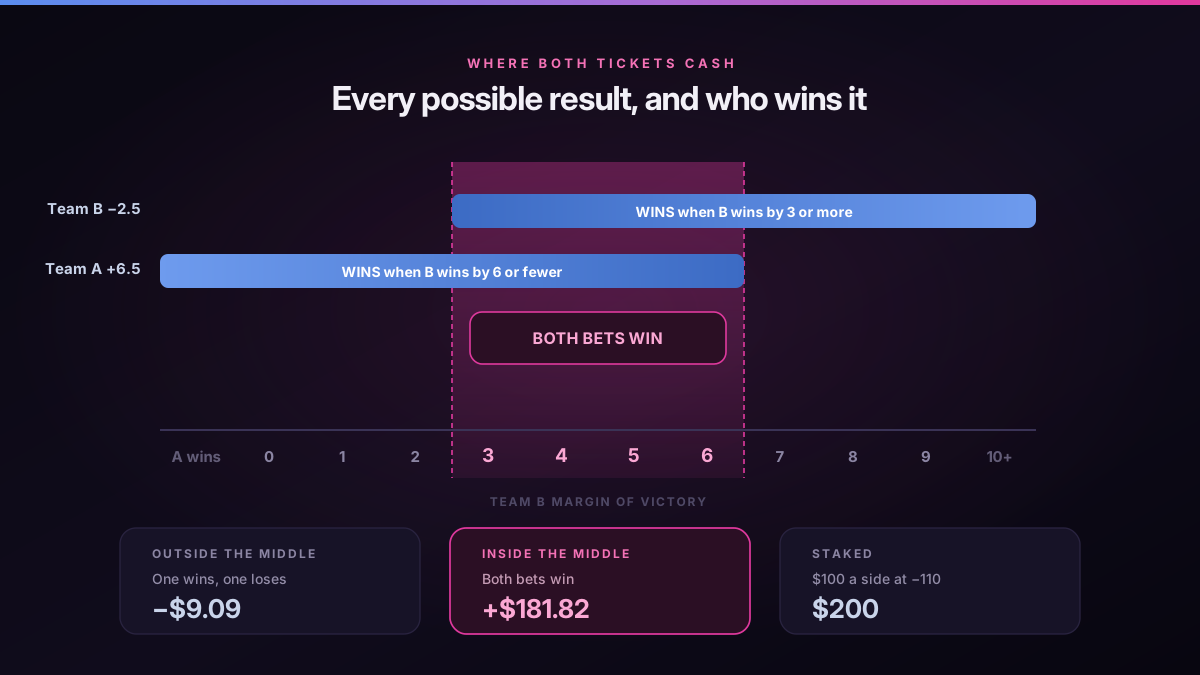
| Team B wins by 3, 4, 5 or 6 | Wins | Wins | Both cash |
| Team B wins by 1 or 2, or loses | Loses | Wins | One of two |
Four numbers where both tickets win. That window is the middle.
The Risk and Reward
This is the part that makes middling worth understanding, because the shape of the bet is unusual.
Put 100 dollars on each side at minus 110.
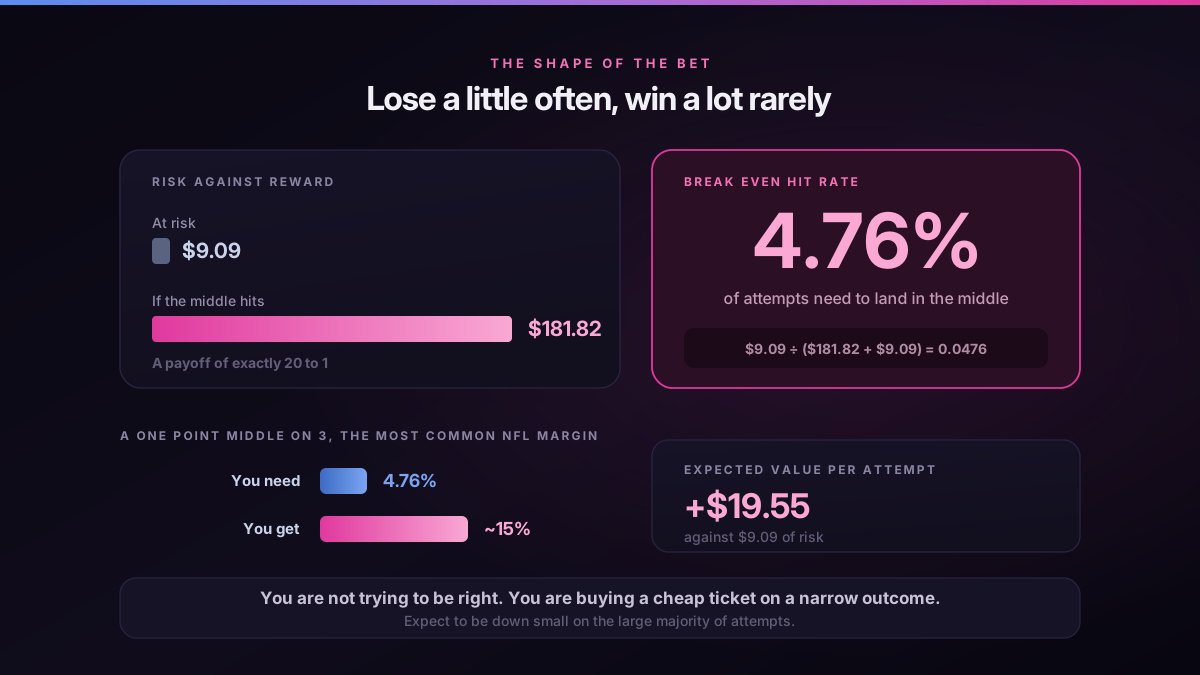
If the game lands outside the middle, one bet wins 90.91 dollars and the other loses 100. You are down 9.09 dollars. That is the worst case, and it happens most of the time.
If the game lands inside the middle, both bets win. You collect 90.91 twice, for 181.82 dollars.
$9.09
Most you can lose
$181.82
If the middle hits
20 to 1
Payoff ratio
4.76%
Break-even hit rate
So you are risking 9.09 to win 181.82, a payoff of exactly 20 to 1. Which means the middle only needs to land 4.76 percent of the time for the play to break even. Anything above that is profit.
That threshold is low enough to change how you think about the whole thing. You are not trying to be right. You are buying a cheap ticket on a narrow outcome, and you only need it to come in occasionally.
Middling Compared to Arbitrage
These two get confused constantly, and the difference is worth being precise about.
Arbitrage is a locked outcome. You cover every result, the numbers guarantee a profit, and the size of that profit is known before the game starts. There is no scenario where you lose and no scenario where you win big.
Middling is the opposite shape. You lose a little most of the time and win a lot occasionally. Nothing is guaranteed, and the expected value lives entirely in how often the middle lands.
| Arbitrage | Middling | |
|---|---|---|
| Typical outcome | Small guaranteed profit | Small loss |
| Best case | Same small profit | Large win |
| Certainty | Guaranteed | Probabilistic |
| What decides it | The prices | The numbers and the sport |
Why the Numbers Matter More Than the Width
A four point middle sounds better than a one point middle. Often it is not, and this is where most explanations stop short.
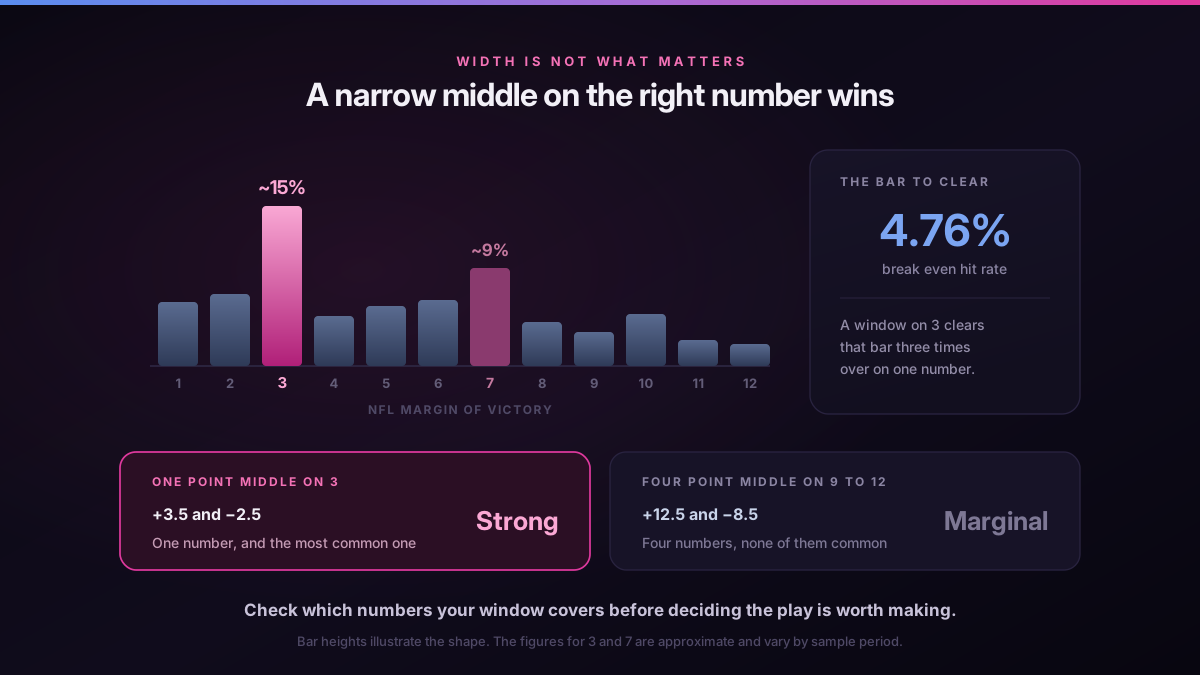
Football scores are not evenly distributed. A margin of exactly three points occurs in roughly 15 percent of NFL games, far more than any other number, with seven the next most common at around 9 percent. Everything else is considerably rarer.
So the value of a middle depends almost entirely on which numbers it spans, not how many.
Consider a one point middle built on three. You hold plus 3.5 on one side and minus 2.5 on the other, so both bets win if the favourite wins by exactly three. That is a single number, but it is the single most common result in the sport.
At roughly 15 percent against a break even requirement of 4.76 percent, that play carries an expected value of about 19.55 dollars per attempt, risking 9.09. A narrow middle on the right number beats a wide one on dead numbers comfortably.
The same logic drives spread shopping generally, which is covered in our guide to line shopping.
Middling Totals
Everything above applies to totals, and totals middles are frequently easier to find because the lines move further.
Bet over 44.5 early. Weather clears, both offences get good news, and the total climbs to 48.5. Take the under 48.5.
Both bets win if the game lands on 45, 46, 47 or 48. Outside that range you lose the same 9.09 dollars.
Totals middles tend to span more numbers, though the key number effect is weaker than it is on spreads, so the arithmetic matters more and the intuition matters less.
Where Middles Come From
You cannot plan a middle in advance. You can only put yourself in position for one, and that means knowing what moves lines.
Injury news is the biggest single driver. A starting quarterback ruled out moves a spread several points in minutes.
Weather moves totals hard, particularly wind in outdoor football games.
Sharp money moves lines steadily through the week as informed bettors take a position, which is why early numbers and closing numbers often differ by a meaningful amount.
Public money on marquee teams pushes lines past where the market thinks they belong, creating gaps against sharper books.
The practical requirement is accounts at several sportsbooks and the habit of watching where numbers sit rather than just taking the first price you see. The same account spread that makes middling possible is what makes arbitrage and value betting possible.
Sizing the Two Sides
The example above used equal stakes on both sides, which is the simplest approach and usually fine when both prices are similar.
When the prices differ meaningfully, you may want to size the two sides so that the non-middle outcomes cost you the same amount either way, rather than losing more in one direction than the other. The arithmetic is the same stake balancing used for arbitrage, so the calculator below handles it.
Calculate your hedge bets for guaranteed profit
Total Stake
$200.00
Total Payout
$0.00
Profit (-100%)
$-200.00
Enter the two prices and it will show you the stake split. For a middle, treat the output as your starting point and then decide whether you want to lean either way.
The Risks Worth Knowing
It is a losing play most of the time. You should expect to be down small on the large majority of attempts. If that pattern will push you into chasing, middling is not for you.
It needs volume and patience. A 4.76 percent break even point means the maths only asserts itself over many attempts. A handful of tries tells you nothing.
Capital gets tied up. The example risks 9.09 dollars but requires 200 dollars committed across two books until the game settles.
It draws attention. Taking both sides of the same game across different sportsbooks is a recognisable pattern. Our guide to why sportsbooks limit winning bettors covers which behaviours get accounts restricted and how to extend an account's useful life.
Half points are everything. A middle built on whole numbers introduces pushes, which changes the arithmetic. Working with half point lines on both sides keeps the outcomes clean.
The Bottom Line
Middling means holding both sides of a game at different numbers so that a range of results pays you twice. At standard pricing you risk about 9 dollars to win about 182, which means the middle only has to land 4.76 percent of the time to break even.
What decides whether any particular middle is worth taking is not how wide the window is, but which numbers sit inside it. A single point middle on three is a strong play in the NFL. A four point middle on numbers nobody lands on is not.
Watch for line movement, keep accounts at several books so you can take both numbers, and work out the window before you commit rather than after.

Please play responsibly. Sports betting carries real financial risk, and no tool or strategy guarantees a profit. If gambling is affecting your life, free and confidential support is available through the National Council on Problem Gambling. Must be of legal age in your jurisdiction.